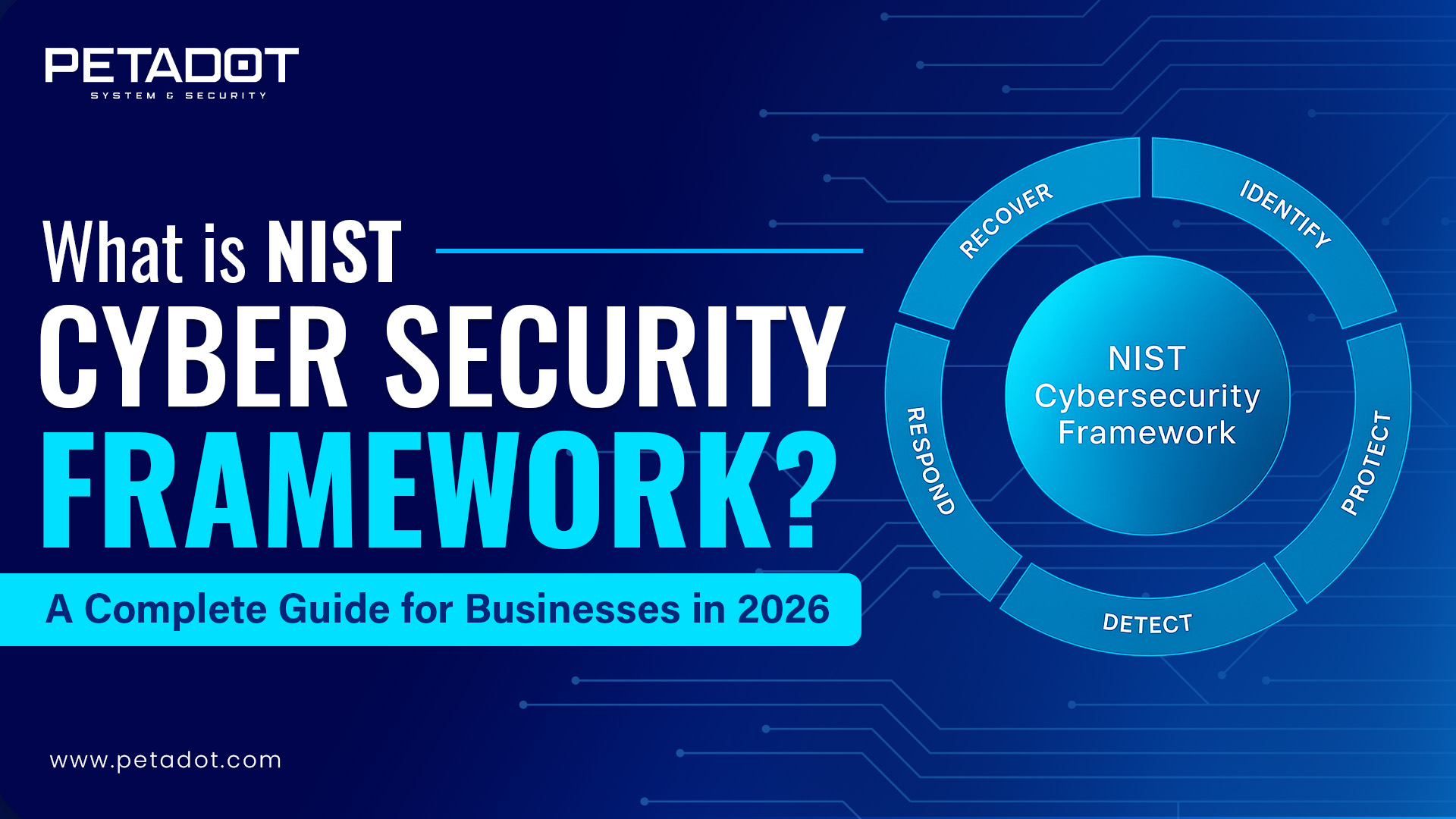
With each passing year, cyber threats become more complex. Ransomware, phishing, and various data breaches are just some examples that make business owners think about their own security. To assist companies in improving their cybersecurity status, the National Institute of Standards and Technology created a widely used cybersecurity framework called the NIST Cybersecurity Framework (NIST CSF).
What is the NIST Cybersecurity Framework? An excellent tool for understanding, managing, and minimizing cybersecurity threats. It will help you to assess your cybersecurity status, determine the gaps, and develop a plan for making your company more resilient.
Table of Contents
What is NIST Cybersecurity Framework?
Every year, cyber threats become more sophisticated. Among ransomware, phishing, and other data breaches, many business owners start thinking about the protection of their own businesses. In order to help companies increase their level of cybersecurity status, the National Institute of Standards and Technology came up with a cybersecurity framework known as the NIST Cybersecurity Framework (NIST CSF).
The NIST Cybersecurity Framework is a fantastic way of managing and reducing cybersecurity threats. With the help of this framework, you will be able to evaluate your current cybersecurity status, find the weaknesses, and create a plan to improve it.
This guide will tell you everything you need to know about the NIST Cybersecurity Standards Framework, including its operation, main purposes, benefits, implementation steps, and why it is one of the most popular cybersecurity frameworks in 2026.
Why Is the NIST Cybersecurity Framework Important?
In today’s digital world, organizations depend upon advanced digital tools, interconnected networks and infrastructure. With the increase in the level of cyber attacks, there is a need for an organized risk management process.
NIST Cyber Security Framework assists organizations in:
- Recognizing their cybersecurity risks
- Improving their security governance structure
- Reducing vulnerabilities
- Improving their incident handling capabilities
- Complying with regulatory compliance
- Building trust in customers
- Ensuring organizational resilience
It doesn’t matter whether an organization has 10 employees or 10,000; the framework can benefit everyone.
The History of the NIST Cybersecurity Framework
The NIST Cybersecurity Framework was created after concerns about increasing cyberattacks targeting critical infrastructure sectors such as:
- Energy
- Transportation
- Healthcare
- Financial services
- Telecommunications
- Water systems
The first version was released in 2014 and quickly gained popularity due to its practical and flexible approach.
Over the years, NIST released updates to address emerging threats and technological advancements. The framework continues to evolve to support modern security challenges such as:
- Cloud computing
- Remote work
- Artificial intelligence
- Supply chain security
- Zero Trust architectures
- Ransomware protection
Today, the framework is considered one of the most influential cybersecurity standards globally.
Core Componentbhejo NIST Cybersecurity Framework
The NIST Cybersecurity Framework consists of three major components:
- Core Functions
- Implementation Tiers
- Profiles
Together, these components help organizations assess and improve their cybersecurity programs.
NIST CSF Core Functions
The framework is built around six primary functions that represent the lifecycle of cybersecurity risk management.
1. Govern
Govern establishes cybersecurity oversight and risk management processes across the organization.
This function focuses on:
- Cybersecurity policies
- Risk management strategy
- Compliance requirements
- Leadership accountability
- Roles and responsibilities
Governance ensures cybersecurity aligns with business objectives.
Example
A company creates security policies, assigns cybersecurity responsibilities, and regularly reviews risks at the executive level.
2. Identify
The Identify function helps organizations understand their assets, systems, data, and risks.
Key activities include:
- Asset management
- Business environment analysis
- Risk assessment
- Supply chain risk management
- Data classification
Organizations cannot protect what they do not know exists.
Example
Maintaining an inventory of servers, laptops, cloud resources, applications, and sensitive information.
3. Protect
The Protect function focuses on implementing safeguards to reduce cybersecurity risks.
Areas covered include:
- Access control
- Employee awareness training
- Data protection
- Encryption
- Identity management
- Endpoint security
Example
Using multi-factor authentication (MFA), encryption, and strong password policies.
4. Detect
Detect focuses on identifying cybersecurity incidents quickly.
Activities include:
- Security monitoring
- Threat detection
- Log analysis
- Intrusion detection systems
- Continuous monitoring
Early detection minimizes potential damage.
Example
A Security Operations Center (SOC) monitors suspicious login attempts in real time.
5. Respond
The Respond function outlines actions to take after detecting a cybersecurity incident.
Key elements include:
- Incident response planning
- Communications
- Analysis
- Mitigation
- Reporting
Example
A company activates its incident response team after discovering ransomware activity.
6. Recover
Recovery ensures organizations can restore operations following a cybersecurity incident.
Activities include:
- Backup restoration
- Disaster recovery
- Business continuity planning
- Lessons learned reviews
Example
Recovering business systems from secure backups after a cyberattack.
Understanding NIST Implementation Tiers
Implementation Tiers help organizations evaluate the maturity of their cybersecurity practices.
There are four tiers:
Tier 1: Partial
Organizations have limited cybersecurity awareness and informal processes.
Characteristics:
- Reactive security practices
- Minimal risk management
- Inconsistent controls
Tier 2: Risk-Informed
Organizations understand cybersecurity risks, but processes are not fully standardized.
Characteristics:
- Basic risk assessments
- Some security policies
- Growing awareness
Tier 3: Repeatable
Cybersecurity processes are documented and consistently implemented.
Characteristics:
- Formal governance
- Regular monitoring
- Organization-wide security practices
Tier 4: Adaptive
Organizations continuously improve cybersecurity practices based on lessons learned and threat intelligence.
Characteristics:
- Advanced threat detection
- Proactive risk management
- Continuous improvement
Most mature organizations aim for Tier 3 or Tier 4.
What Are NIST Profiles?
Profiles help organizations align cybersecurity activities with business goals and risk tolerance.
A profile consists of:
Current Profile
Represents the organization’s existing cybersecurity posture.
Target Profile
Represents desired cybersecurity outcomes.
Gap Analysis
Identifies differences between the current and target states.
Organizations use profiles to create strategic cybersecurity improvement plans.
Benefits of the NIST Cybersecurity Framework
The NIST Cybersecurity Framework offers numerous advantages.
1. Improved Risk Management
Organizations can identify, assess, and prioritize cybersecurity risks more effectively.
2. Flexible and Scalable
The framework can be used by:
- Small businesses
- Medium enterprises
- Large corporations
- Government agencies
3. Better Compliance
NIST CSF supports compliance efforts related to:
4. Enhanced Incident Response
Organizations can detect and respond to threats more efficiently.
5. Increased Cyber Resilience
The framework helps organizations maintain operations during and after cyber incidents.
6. Improved Communication
It creates a common language for executives, IT teams, and security professionals.
How to Implement the NIST Cybersecurity Framework
Implementing NIST CSF involves several practical steps.
Step 1: Understand Organizational Objectives
Identify:
- Business goals
- Critical services
- Regulatory requirements
- Risk tolerance
Step 2: Inventory Assets
Create an inventory of:
- Hardware
- Software
- Cloud resources
- Data assets
- Third-party systems
Step 3: Assess Current Security Posture
Evaluate existing controls and cybersecurity maturity.
Questions include:
- What security measures already exist?
- Where are the weaknesses?
- What threats are most likely?
Step 4: Conduct Risk Assessment
Analyze:
- Threats
- Vulnerabilities
- Business impact
- Likelihood of attacks
This helps prioritize security investments.
Step 5: Develop a Target Profile
Define desired cybersecurity outcomes.
Examples:
- Deploy MFA organization-wide
- Implement continuous monitoring
- Improve incident response capabilities
Step 6: Identify Gaps
Compare current and target profiles to identify missing controls.
Step 7: Create an Action Plan
Prioritize security initiatives based on risk and business impact.
Examples:
- Employee training
- Security monitoring
- Network segmentation
- Vulnerability management
Step 8: Monitor and Improve Continuously
Cybersecurity is not a one-time project.
Organizations should:
- Perform regular assessments
- Review policies
- Test incident response plans
- Update controls based on emerging threats
NIST Cybersecurity Framework vs ISO 27001
Many organizations compare NIST CSF with ISO 27001.
| Feature | NIST CSF | ISO 27001 |
|---|---|---|
| Purpose | Risk management framework | Information security management standard |
| Certification | No certification | Certification available |
| Flexibility | Highly flexible | More structured |
| Cost | Generally lower | Certification costs involved |
| Adoption | Widely used globally | Internationally recognized |
Many organizations use both frameworks together for stronger cybersecurity governance.
Industries That Use the NIST Cybersecurity Framework
The framework has applications in a wide range of industries.
- Healthcare Industry: Safeguards patients’ information and health care systems from cyber attacks.
- Financial Services: Improves the security of banking activities and financial transactions.
- Government Agencies: Facilitate the securing of critical infrastructure and sensitive information.
- Manufacturing Industry: Minimizes cybersecurity risks in manufacturing environments and industrial controls.
- Technology Sector: Boosts cloud, application, and data security.
- Educational Institutions: Protect students’ information, research data, and educational networks.
Common Challenges in NIST Framework Adoption
Despite being effective, implementation may pose certain difficulties.
- Low Budget: Small companies might face some problems when it comes to securing enough budget for cybersecurity efforts.
- Lack of Qualified Specialists: Attracting and maintaining competent cybersecurity specialists might be difficult.
- Old Technologies: Older systems may not have capabilities for implementing new controls and approaches.
- Corporate Resistance: Employees or management can be resistant to necessary changes to improve cybersecurity.
- Ongoing Efforts: The framework needs continuous updates and improvements.
Organizations capable of overcoming these difficulties can build robust cybersecurity.
Best Practices for NIST Cybersecurity Framework Success
For optimal outcomes:
- Gain executive buy-in
- Perform continuous risk assessments
- Perform continuous employee training
- Enable multi-factor authentication
- Provide 24/7 system monitoring
- Perform continuous testing of response plans
- Secure third-party providers
- Maintain current asset inventory
- Perform a vulnerability assessment
- Improve controls continuously
These practices strengthen overall cybersecurity resilience.
The Future of the NIST Cybersecurity Framework
With the evolution of cyber threats, the NIST Cybersecurity Framework keeps on updating itself.
Future focus areas will be:
- Artificial Intelligence Security
- Cloud-Native Security
- Risk Management for Supply Chain
- Zero Trust Architecture
- OT Security
- Protection of Critical Infrastructure
- Integration of Threat Intelligence
Companies implementing the framework today position themselves to address tomorrow’s cybersecurity challenges more effectively.
Conclusion
NIST Cybersecurity Framework is one of the most reliable and widely used frameworks for managing cyber risks worldwide. The framework gives businesses an effective way to identify, protect, detect, respond to, and recover from various cyber threats.
Through adoption of the NIST Cybersecurity Framework, businesses will be able to enhance their security profile, minimize cyber risks, strengthen compliance efforts, and become more resilient to various types of threats. As a business owner, IT manager, or a company that wants to build a mature cybersecurity program in 2026, NIST CSF can be a good starting point.
FAQs
1. What is the NIST Cybersecurity Framework?
A cybersecurity framework that helps organizations manage and reduce cyber risks.
2. What are the core functions of NIST CSF?
Govern, Identify, Protect, Detect, Respond, and Recover.
3. Who can use the NIST Cybersecurity Framework?
Businesses, government agencies, healthcare providers, and organizations of all sizes.
4. What are the benefits of NIST CSF?
Improved security, risk management, compliance, and incident response.
5. Is the NIST Cybersecurity Framework mandatory?
No, it is voluntary but widely adopted as a cybersecurity best practice.
Suggestions:
- https://petadot.com/blog/soc-2-compliance-services-guide/
- https://petadot.com/blog/incident-response-plan-for-b2b-services-firms/
- https://petadot.com/blog/how-to-prevent-cyber-attacks-in-healthcare/
- https://petadot.com/blog/top-cyber-security-companies-in-hyderabad-2026/
- https://petadot.com/blog/ransomware-readiness-assessment-guide/
- https://petadot.com/blog/breach-and-attack-simulation/
- https://petadot.com/blog/criminals-plan-cyber-attacks/
- https://petadot.com/blog/red-teaming-in-cybersecurity-a-complete-guide/
- https://petadot.com/blog/cloud-vapt-securing-aws-azure-and-gci/
- https://petadot.com/blog/what-is-zero-day-vulnerability-vapt/