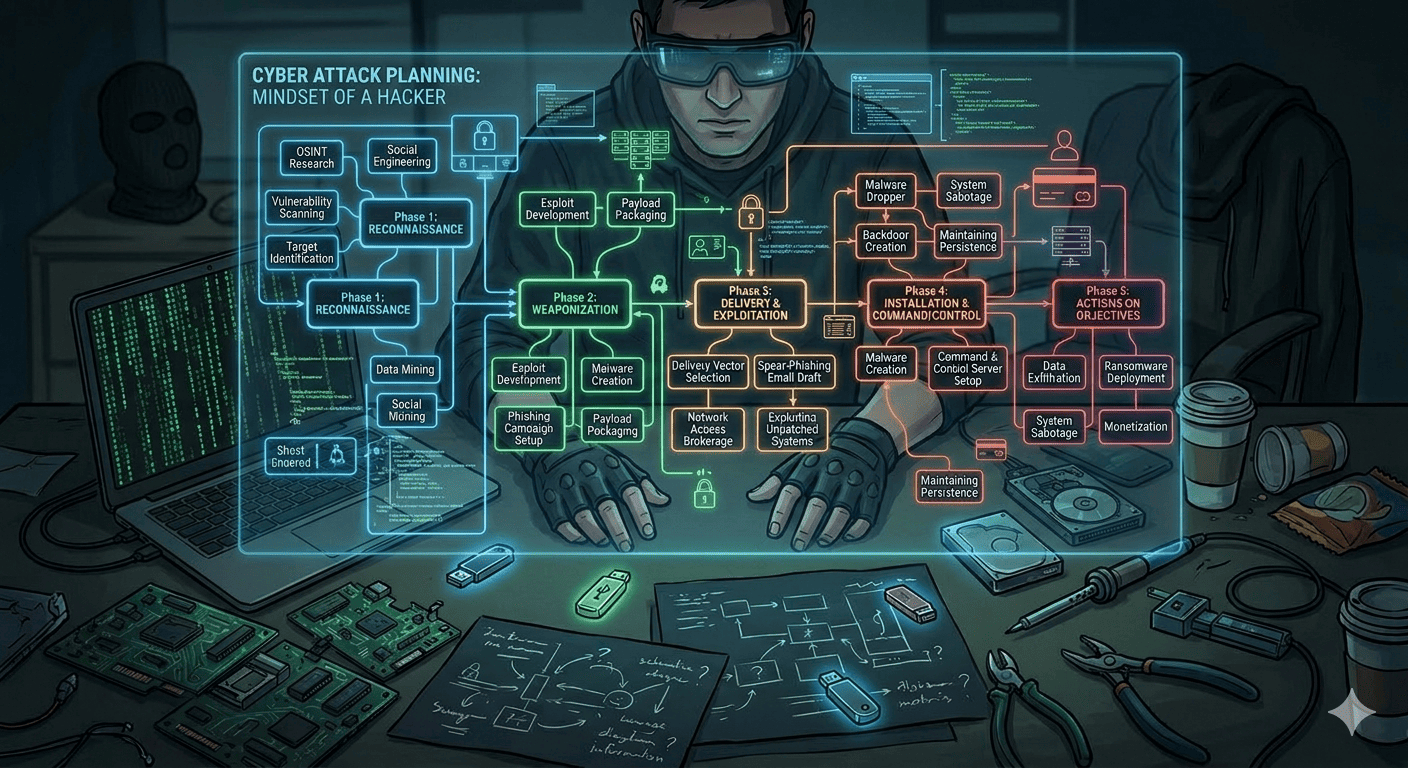
Cybercrime has emerged as one of the biggest dangers in the digital age. From small-scale businesses to multinational companies, businesses are regularly attacked by cybercriminals seeking to snare data, disrupt services or even gain financial gain. Knowing how Criminals Plan Cyber Attacks is crucial for companies as well as individuals looking to secure their systems and data.
Cybercriminals don’t attack systems randomly. Instead, they employ an established process of conducting research, planning, testing vulnerabilities, and carrying out sophisticated attacks. This article provides the entire process of a cyberattack as well as the methods hackers employ, and the ways businesses can safeguard themselves.
Understanding Criminals Plan Cyber Attacks and Their Motives
Before understanding the process of cyber attacks, it is essential to know why cybercriminals launch these attacks in the first instance. Cyberattacks aren’t always random; they are typically motivated by specific motives that favor the victim in some way. Understanding the motivations behind these attacks helps cybersecurity professionals detect threats early and create stronger defense strategies.
Cyberattacks’ motivations generally fall into a variety of major categories.
Financial Gain
One of the most frequent motives behind cyberattacks is financial gain. Cybercriminals target organizations and individuals to steal money or financial data.
The goal is usually to rob:
- Credit card details
- Credentials for online banking
- Information on the Payment Gateway
- Bitcoin wallets
Attackers can also use ransomware that locks files and demands payment for access to the files.
Corporate Espionage
Certain cyberattacks are carried out to gain an advantage over competitors. In these instances, attackers attack companies in order to steal confidential information about business.
This could include:
- Trade secrets
- Product designs
- Data on research and development
- Customer databases
- Intellectual property
Espionage on corporate networks is usually specifically targeted and well-planned.
Political or Ideological Motives
Certain cyberattacks are motivated by ideologies or political agendas. Groups that are politically motivated or hacktivists could target websites or government agencies to promote their agenda or express their displeasure with certain policies.
These attacks can be a result of:
- Website defacement
- Data leaks
- Distributed denial-of-service (DDoS) attacks
- Service interruptions
The aim is typically to raise awareness, change the public’s opinion, or disrupt the operation.
Data Theft
In most cases, cybercriminals concentrate on stealing sensitive personal information. These data may later be sold to underground marketplaces or used to commit identity theft and other fraud.
Commonly targeted information comprises:
- Email accounts
- Login credentials
- Personal identification documents
- Customer databases
- Medical documents
Data stolen from a computer is very important in the cybercrime market.
Revenge or Personal Motives
Some cyberattacks are from hackers who are external to the system. Sometimes the threat is posed by insiders, like unhappy employees or former employees.
Insiders from these groups may possess access to corporate systems, and they could use their rights to:
- Leak confidential information
- Internal systems are damaged
- Delete important data
- Interrupt operations
Understanding these reasons allows companies to identify potential threats and put in place proactive security measures.
Is Your Business Prepared for a Cyber Attack?
Cyber criminals constantly look for vulnerabilities to exploit. Strengthen your defenses with professional
Vulnerability Assessment & Penetration Testing (VAPT), SOC monitoring, and advanced cybersecurity solutions from Petadot experts.
The Cyber Attack Lifecycle
1. Reconnaissance (Information Gathering)
The initial stage of any cyberattack is reconnaissance. In this stage, hackers collect as much information as they can regarding the target company.
The aim is to discover possible weaknesses that could then be exploited.
Hackers usually collect data like:
- Websites for companies
- Profiles of social media accounts for employees
- Technology infrastructure
- Network architecture
- Employees’ email addresses
- Domain registration details
Common Reconnaissance Techniques
Attackers employ various strategies in this stage.
Open Source Intelligence (OSINT)
Attackers collect public information from online sources, such as corporate websites, LinkedIn profiles, social media platforms, and publicly published documents.
Network Scanning
Hackers scan networks and systems to find servers, ports that are open ports, and possible weaknesses.
Social Engineering Research
Cybercriminals study employee behavior, roles, and communication patterns to craft convincing phishing attacks.
The goal of reconnaissance is to find vulnerable entry points within the security system.
2. Scanning and Vulnerability Identification
Once the attackers have gathered enough information about their subject, they begin to search the system for any vulnerabilities.
In this stage, attackers search for weaknesses, such as
- Old software
- Passwords that are weak or used repeatedly
- Servers not properly configured
- Open network ports
- Security patches missing
Hackers typically make use of automated tools, also known as vulnerability scanners, to detect these weaknesses quickly.
These vulnerabilities are like an open door that attackers could be able to exploit to gain unauthorised access. Businesses that fail to frequently update their system and patches regularly are easy targets.
3. Weaponization
Once they have identified vulnerabilities, cybercriminals then move on to the stage of weaponization.
In this stage, hackers develop their tools as well as malicious programs that are required to exploit the vulnerabilities they have discovered.
Common tools used to attack are:
- Malware
- Ransomware
- Trojan programs
- Exploit kits
- Malicious scripts
They are designed to circumvent security measures as well as gain entry to the targeted system.
For instance, attackers could disguise malware as an email attachment or even embed it in an untrusted website link.
4. Delivery of the Attack
The delivery process involves delivering malware to a system that is targeted.
Cybercriminals employ a variety of ways to carry out their attacks.
Common Attack Delivery Methods
Phishing Emails
Phishing is among the commonly used techniques for cyberattacks. The attackers send emails that appear to be genuine in order to lure victims to click on malicious links or download malicious attachments.
Malicious Websites
Attackers could make fake websites or attack legitimate websites to spread malware to unwitting users.
USB Devices
In certain cases, hackers are able to leave infected USB drives at public places, hoping that they will be connected to computers.
Software Exploits
Cybercriminals may exploit vulnerabilities in outdated software or applications to gain system access.
After the malicious payload has been delivered, the attack is moved to the next phase.
5. Exploitation
In the exploit phase, the attacker is able to take advantage of the vulnerability that was discovered earlier.
In this case, malware is executing on the system of the target.
This lets attackers:
- Gain unauthorized system access
- Install malware-based software
- Escalate user rights
- Explore the deeper parts of the company’s network
If the system is not equipped with robust security measures, hackers could quickly spread their access to multiple servers and devices.
6. Installation of Malware
Once they gain control of the machine, hackers install malware to ensure that they remain in control.
This will ensure that, even if the system has been restarted, the attacker will be able to gain access.
Common types of malware are:
- Remote Access Trojans (RATs)
- Keyloggers
- Spyware
- Ransomware
These tools enable attackers to track user activity, capture sensitive data, and keep a long-term watch on an infected system.
7. Command and Control (C2)
After malware has been installed, attackers are able to communicate with the system infected via Control and Control (C2) servers.
These servers permit attackers to remotely manage the compromised systems.
Through the C2 infrastructure, attackers could:
- Perform commands on systems that are infected.
- Upload or download files
- Monitor the system’s activities
- Create further attacks
In many instances, compromised systems are put together to create the term botnet that could be used to conduct massive cyberattacks.
8. Actions on Objectives
This is the end of the cyber attack’s lifecycle.
In this moment, the attackers accomplish their primary goal.
Based on their objectives, they could:
- Steal sensitive data
- Encrypt files using ransomware
- Conduct financial fraud
- Stop the business processes
- Destroy vital systems
- Infect networks with malware
A few cybercriminals are hidden within systems for months prior to launching their final attack and allowing them to gather valuable data over time.
Common Techniques Used by Cybercriminals
Cybercriminals employ a variety of techniques to hack into systems and steal confidential information. The methods they employ are continually evolving as attackers develop more sophisticated techniques to circumvent security barriers. Recognizing these tactics is vital for businesses seeking to enhance their security posture.
The most commonly used attack strategy is to use malware.
Phishing Attacks
Phishing scams trick victims into sharing sensitive information, such as passwords and credit card numbers.
The emails that appear to be from reputable organisations.
Malware Attacks
Malware is malicious software that is designed to harm, disable, or gain access to computers. After being installed on a system, malware may take over data, track user activity, and provide attackers with remote control over affected devices.
Some of the most well-known kinds of malware are:
- Viral infections are programs that attach themselves to files and then propagate when the files are shared or opened.
- Worms are self-replicating malware that is distributed automatically across networks with no human intervention.
- Trojans are malware disguised as legitimate software that fool users into installing them.
- Ransomware malware that encrypts files and asks for payment to regain access.
- Spyware Software that monitors user activity and records sensitive information.
Malware attacks can cause severe harm to businesses, such as data breaches, financial losses and disruptions to operations.
Password Attacks
Poor password security is among the most prevalent security weaknesses in companies. Cybercriminals typically exploit weakly secure accounts in order to get access to systems as well as sensitive information.
Most attackers use a variety of methods to break passwords, including:
Attackers commonly use several techniques to crack passwords, such as:
- Brute Force Attacks – Try all possible combinations of passwords till the right one is discovered.
- Dictionary Security Attacks: Utilizing an array of common passwords or words to figure out passwords to log in.
- Credit Card Stuffing – Making use of previously leaked passwords and usernames to access multiple accounts.
Secure password policies and multi-factor authentication are a great way to lower the chance of attacks based on passwords.
Man-in-the-Middle Attacks
A Man-in-the-Middle (MITM) Attack is when a thief secretly intercepts the communication between two people.
In this kind of attack, cybercriminals place themselves between the sender and the recipient and allow them to:
- Monitor communications
- Capture sensitive data
- Modify the information that is transmitted
- redirect users to malicious websites
The attacks are usually in public Wi-Fi networks that are insecure or communication channels that are poorly secured.
Insider Threats
The majority of cyber-attacks do not originate from outside attackers. Sometimes, the threat originates from people within the company itself.
An insider risk is when contractors, employees, or partners abuse their access rights.
Insiders from these groups could:
- Leak confidential information
- Use stolen company data
- Internal systems are being sabotaged
- Data that is sensitive can be exposed accidentally due to carelessness
Since insiders already have authorization access to systems, identifying these types of threats can be difficult.
Stop Hackers Before They Exploit Your Systems
Cyber attackers plan every step before launching an attack. Identify vulnerabilities early with professional
Vulnerability Assessment & Penetration Testing (VAPT) and advanced cybersecurity services from Petadot System & Security Pvt. Ltd.
How Organizations Can Prevent Cyber Attacks
To prevent cyberattacks, you must implement a proactive approach to cybersecurity instead of merely reacting to attacks after they have occurred. Businesses must employ a layered security plan that includes technological controls, employee awareness, and constant monitoring.
Below are a few essential cybersecurity techniques that can help businesses secure their data and systems.
Conduct Regular Security Assessments
Regular security audits help companies find vulnerabilities before attackers take advantage of them.
Companies should conduct the vulnerability Assessment as well as Penetration Testing (VAPT) to assess how secure their infrastructure is.
Cybersecurity firms like Petadot System and Security Pvt. Ltd. offer professional VAPT solutions that simulate real-world cyberattacks. These tests aid organizations in identifying weaknesses that are not obvious and help them strengthen their security.
Implement Strong Access Controls
Controlling who is able to access systems and data is essential in preventing unauthorised access.
The organizations should establish strong access control measures, such as:
- Multi-Factor authentication (MFA) to add a layer of security for logins
- Secure passwords that require complicated passwords
- The Role-based Access Control (RBAC) to limit access based on the job’s duties
These measures of security significantly lower the chance of a data breach.
Keep Systems Updated
Software that is outdated is among the most frequent ways to be a victim of cyberattacks. Software companies frequently release updates, which include critical security patches.
The organizations should make sure that they are regularly updating:
- Operating systems
- Software applications
- Databases and servers
- Network devices like routers and firewalls
Maintaining systems up-to-date helps in closing security gaps that attackers could exploit.
Employee Security Awareness Training
Human error is among the most common reasons for cybersecurity incidents. Employees who aren’t aware of cyber-related threats may accidentally expose their company to risk.
The company should provide regular cybersecurity awareness training so that employees can:
- Know when phishing emails are sent out
- Avoid clicking suspicious links
- Handle sensitive data securely
- Notify the system of unusual activity immediately
Employers who are well-educated serve as the primary protection against cyberattacks.
Deploy Advanced Security Monitoring
Monitoring continuously helps companies identify suspicious activity and react quickly to threats.
Businesses must implement modern security technology, including:
- Security Operations Centers (SOC) for real-time threat monitoring
- Intrusion Detection Systems (IDS) to identify suspicious network activities
- Endpoint Detection and Response (EDR) to protect each device
Cybersecurity companies such as Petadot Systems and Security Pvt. Ltd. provide Managed Security Services that provide continuous monitoring of the security system and quick response.
The Growing Importance of Cybersecurity
As the digital revolution accelerates across industries, companies are becoming more dependent on technologies and infrastructure. While this is a great transformation that has numerous advantages but also exposes them to cyber-attacks.
Cybercriminals are constantly creating more sophisticated attack methods and are making cybersecurity a top issue for modern companies.
Companies must move away from a reactive approach to security that focuses on threats being taken care of after they happen and move to a proactive strategy for cybersecurity, which focuses on prevention, monitoring, and swift reaction.
Knowing the ways cybercriminals plan and carry out attacks helps organizations strengthen their defenses and stay in front of threats that could be coming. Businesses that invest in sophisticated security solutions, regularly conduct vulnerability assessments, and constantly monitor are much better prepared to protect themselves against ever-changing cyber threats.
Conclusion
Cyber attacks are rarely random. Criminals carefully plan their operations using structured processes that include reconnaissance, vulnerability scanning, malware deployment, and system exploitation.
By understanding the methods and mindset of cybercriminals, organizations can strengthen their defenses and reduce the risk of attacks.
Implementing strong cybersecurity practices, conducting regular security testing, and partnering with experts such as Petadot System & Security Pvt. Ltd. can help organizations protect their digital assets from evolving threats.
In today’s digital world, cybersecurity is not just an IT requirement—it is a critical business necessity.
Suggested
- Why You Need to Focus on Mobile Security
- Cloud Security: Protecting Your Digital Assets in the Modern Era
- Types of Cybersecurity
- Avoid Operational Disruptions: Strengthen Your Cybersecurity with SOC
- Is Your Outdated Software Putting Your Business at Risk?
- AES-256-GCM
- What to Do During Cyber Attack
- Why Continuous Vulnerability Management Services
- 5 Cybersecurity Myths That Put Your Business at Risk
- SOVA Android Trojan
- Penetration Testing Companies in india
- Cyber Security Companies in Mumbai
- Cyber Security Companies in Ahmedabad
- VAPT Services in india