Cybersecurity threats are growing in both scale and sophistication. From ransomware campaigns and data breaches to supply-chain attacks, organizations across industries are under constant pressure to protect their digital assets. As reliance on digital infrastructure increases, the demand for VAPT Services in India has grown significantly, helping organizations proactively identify and address security weaknesses.
Among the most dangerous cybersecurity threats are zero-day vulnerabilities, security flaws that attackers exploit before vendors or security teams even know they exist. What makes zero-day attacks especially alarming is the lack of warning and protection. There are no patches, no signatures, and often no immediate indicators of compromise.
This is where proactive security practices such as vulnerability assessment and penetration testing and VAPT testing services become critical. While VAPT cannot instantly patch a zero-day vulnerability, it plays a vital role in reducing risk, improving visibility, and strengthening an organization’s overall security posture.
What Is a Zero-Day Vulnerability?
It’s a previously unknown security flaw in software, hardware, or firmware that attackers can exploit before the vendor or developer becomes aware of it and releases a fix.
In simple terms, it is a weakness that defenders have had zero days to address.
Why Are They Called “Zero-Day”?
The term “zero-day” refers to the fact that once the vulnerability is discovered often by attackers developers have zero days to prepare a patch before exploitation begins. During this window, organizations are exposed with no official defense available.
How Attackers Exploit Zero-Day Vulnerabilities
Attackers exploit zero-day vulnerabilities by:
- Discovering flaws through reverse engineering or fuzz testing
- Developing exploits before public disclosure
- Launching targeted or large-scale attacks while systems remain unpatched
Because traditional security tools rely heavily on known threat signatures, zero-day exploits can bypass antivirus solutions, firewalls, and basic security controls undetected.
How Zero-Day Attacks Work
Typical Attack Lifecycle –
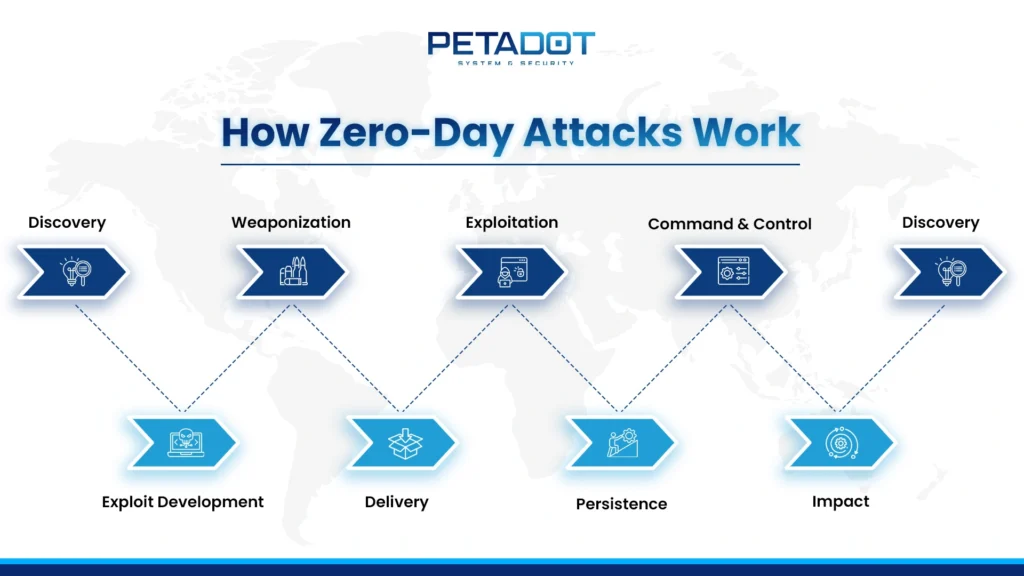
A zero-day attack typically follows this lifecycle:
- Discovery – The attacker identifies an unknown vulnerability
- Weaponization – A working exploit is developed
- Delivery – The exploit is delivered via phishing emails, malicious websites, or network access
- Exploitation – The vulnerability is triggered
- Impact – Data theft, ransomware deployment, or persistent system compromise
Common Entry Points –
Zero-day vulnerabilities commonly exist in:
- Software applications (enterprise platforms, ERP systems)
- Web browsers (Chrome, Firefox, Edge)
- Operating systems (Windows, Linux, macOS)
- Plugins and extensions (PDF readers, media players)
This is why web application security testing, mobile application security testing, and network penetration testing are essential parts of a modern cybersecurity strategy.
Real-World Examples of Zero-Day Attacks
Several high-profile incidents demonstrate the real-world impact of zero-day vulnerabilities:
- Stuxnet exploited multiple zero-day vulnerabilities to target industrial control systems
- Microsoft Exchange zero-day attacks compromised thousands of servers worldwide
- Browser-based zero-day exploits have been widely used in espionage and surveillance campaigns
These incidents clearly show that zero-day vulnerabilities are not theoretical—they are actively exploited with severe business and operational consequences.
Types of VAPT Services
Organizations leveraging VAPT Services in India typically choose from the following security testing offerings:
1. Network VAPT
Evaluates internal and external networks to identify open ports, weak services, and misconfigurations through network penetration testing.
2. Web Application VAPT
Identifies vulnerabilities in web applications based on the OWASP Top 10, forming the foundation of web application penetration testing.
3. Mobile Application VAPT
Assesses Android and iOS applications for insecure storage, authentication flaws, and improper API usage.
4. API VAPT
Focuses on API security testing, identifying broken authentication, authorization bypass, and data exposure risks.
5. Cloud VAPT
Reviews cloud environments for misconfigurations, excessive permissions, and exposed storage using cloud penetration testing techniques.
6. Infrastructure VAPT
Covers servers, databases, operating systems, and middleware to uncover systemic weaknesses.
7. Website VAPT
Website VAPT focuses on identifying security vulnerabilities in websites that attackers commonly target. It includes web application penetration testing to detect OWASP Top 10 issues such as SQL injection, cross-site scripting (XSS), and broken authentication.
How VAPT Supports Compliance and Risk Management
Many regulatory and industry frameworks mandate vulnerability and penetration testing, including:
- PCI DSS for payment security
- HIPAA penetration testing for healthcare organizations
- ISO 27001 risk assessments
- GDPR security controls
By conducting regular vulnerability assessment and penetration testing, organizations demonstrate due diligence, improve governance, and reduce regulatory risk.
How VAPT Helps Mitigate Zero-Day Risks
Identifying Unknown or Hidden Weaknesses
While VAPT testing services cannot directly detect true zero-day vulnerabilities, they uncover indirect weaknesses such as misconfigurations, weak access controls, and excessive privileges that attackers often exploit alongside zero-days.
Simulating Real-World Attack Scenarios
Penetration testing simulates real attacker behavior, helping organizations understand how a zero-day exploit could be leveraged after initial access.
Improving Detection and Response Capabilities
VAPT exercises validate logging, alerting, and incident response workflows, improving readiness against advanced threats.
Reducing the Overall Attack Surface
By fixing known vulnerabilities and hardening systems, organizations significantly reduce the number of attack paths available to attackers.
Limitations of VAPT in Detecting Zero-Day Vulnerabilities
Why Zero-Day Vulnerabilities Are Hard to Detect
By definition, zero-day vulnerabilities are unknown. No scanner, Nessus vulnerability scan, or testing methodology can guarantee detection of vulnerabilities that have not yet been discovered.
Importance of Layered Security Beyond VAPT
VAPT must be part of a defense-in-depth strategy that includes endpoint protection, continuous monitoring, Zero Trust access controls, and threat intelligence.
Best Practices to Protect Against Zero-Day Attacks
- Conduct VAPT testing regularly and after major system changes
- Maintain strong patch and configuration management processes
- Implement network segmentation and Zero Trust principles
- Leverage threat intelligence and continuous monitoring
- Provide ongoing employee security awareness training
Frequently Asked Questions (FAQ)
1. What is VAPT in cyber security?
VAPT in cyber security refers to Vulnerability Assessment and Penetration Testing, a proactive approach to identifying and validating security weaknesses before attackers exploit them.
2. Can VAPT detect zero-day vulnerabilities?
APT cannot directly detect unknown zero-day vulnerabilities, but it significantly reduces zero-day risk by identifying exploitable weaknesses and attack paths.
3. For whom is VAPT audit mandatory?
A VAPT audit is mandatory for:
- Organizations processing card payments (PCI DSS)
- Healthcare organizations handling patient data (HIPAA)
- Companies certified or seeking ISO 27001
- Businesses handling personal data under GDPR
- Banks, fintech, and financial institutions
- Organizations with public-facing websites or applications
4. Why choose Petadot for VAPT Services?
Petadot is a trusted VAPT services provider offering comprehensive vulnerability assessment and penetration testing to help organizations identify risks and strengthen their security posture. With expert-led testing aligned to global standards, Petadot enables businesses to stay resilient against evolving cyber threats.
Conclusion
Zero-day vulnerabilities represent one of the most serious and unpredictable threats in modern cybersecurity. While they cannot be completely prevented, their impact can be significantly reduced through proactive security measures.
VAPT Services in India play a crucial role in identifying weaknesses, validating defenses, and strengthening organizational resilience. As part of a defense-in-depth strategy, vulnerability assessment and penetration testing help organizations stay secure even in the face of unknown threats.